

Exchange failed; Teams calls and calendars split
Overview
Microsoft's outage separated Teams calls from calendar access. We checked its feature report, incident findings and Exchange documentation.
Microsoft listed Teams calls and chat as unaffected while calendar scheduling, invitations and meeting edits were failing. Its 13 November update at 20:02 UTC (opens in a new tab) tied those calendar failures to Exchange Online. A successful Teams call therefore said nothing about the same user’s calendar.
Checked 13 November 2026.
Microsoft’s preliminary findings point to overloaded connection handling
The University of Pennsylvania’s copy of Microsoft’s service-health notices (opens in a new tab) identifies the Exchange incident as EX1550543 and links its wider Microsoft 365 impact to MO1550821. The Exchange entry updated at 20:02 UTC on 13 November still has Root Cause: N/A; its earlier updates contain preliminary findings and mitigation results.
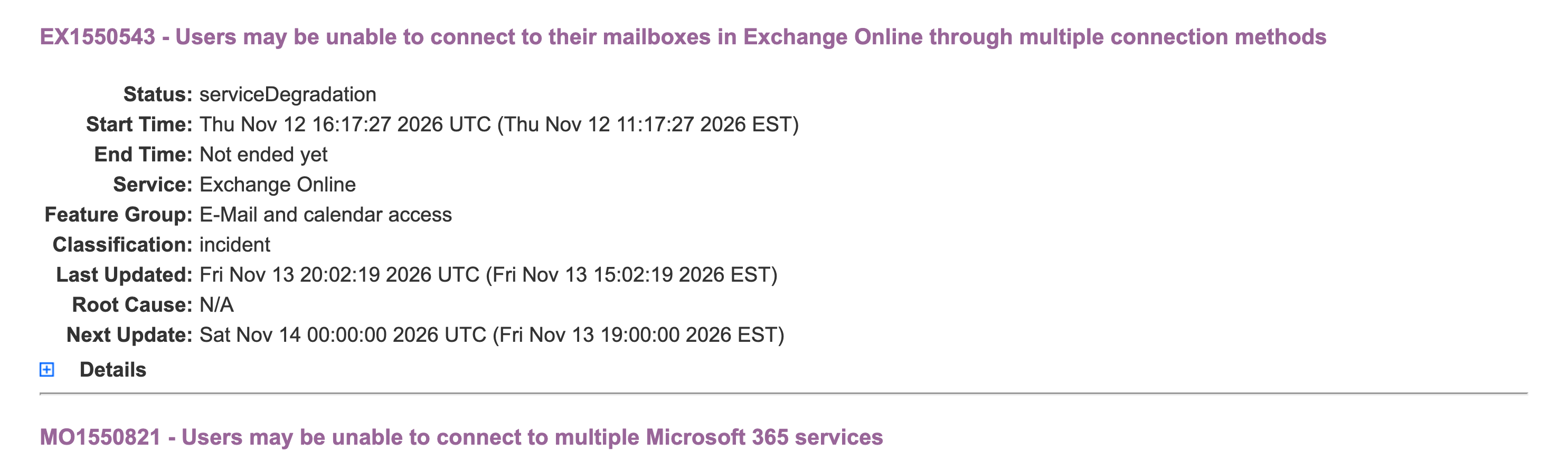
The root-cause field was empty at 20:02 UTC. Captured on Penn’s copy of Microsoft’s tenant notices on 13 November 2026, 20:31 UTC.
| Update time (UTC) | What Microsoft reported |
|---|---|
| 12 Nov, 20:56 | An alternative health-check method let a subset of servers return to service; Microsoft was preparing automated detection and restarts of unresponsive servers. |
| 12 Nov, 23:59 | Recovered servers could become unresponsive again after receiving traffic. Microsoft was testing traffic restrictions and rebuilding a subset with a previous software configuration. |
| 13 Nov, 01:06 | A process responsible for establishing secure connections became overwhelmed, stopping request processing. Microsoft was also reverting a network configuration change that correlated with the start of impact. |
| 13 Nov, 04:59 | Traffic rebalancing contributed to heightened call volume from routing services to backend servers. Machines stuck in a bad state prevented changes from syncing as expected. |
| 13 Nov, 07:25 | A patch to an upstream authentication/routing configuration component produced positive server-stability results on part of the infrastructure. |
| 13 Nov, 08:06 | Microsoft reported increased stability on patched infrastructure and began expanding the patch. |
Source: Microsoft’s EX1550543 updates, republished by Penn (opens in a new tab). These are successive statements from the same investigation, not independent confirmations of a cause.
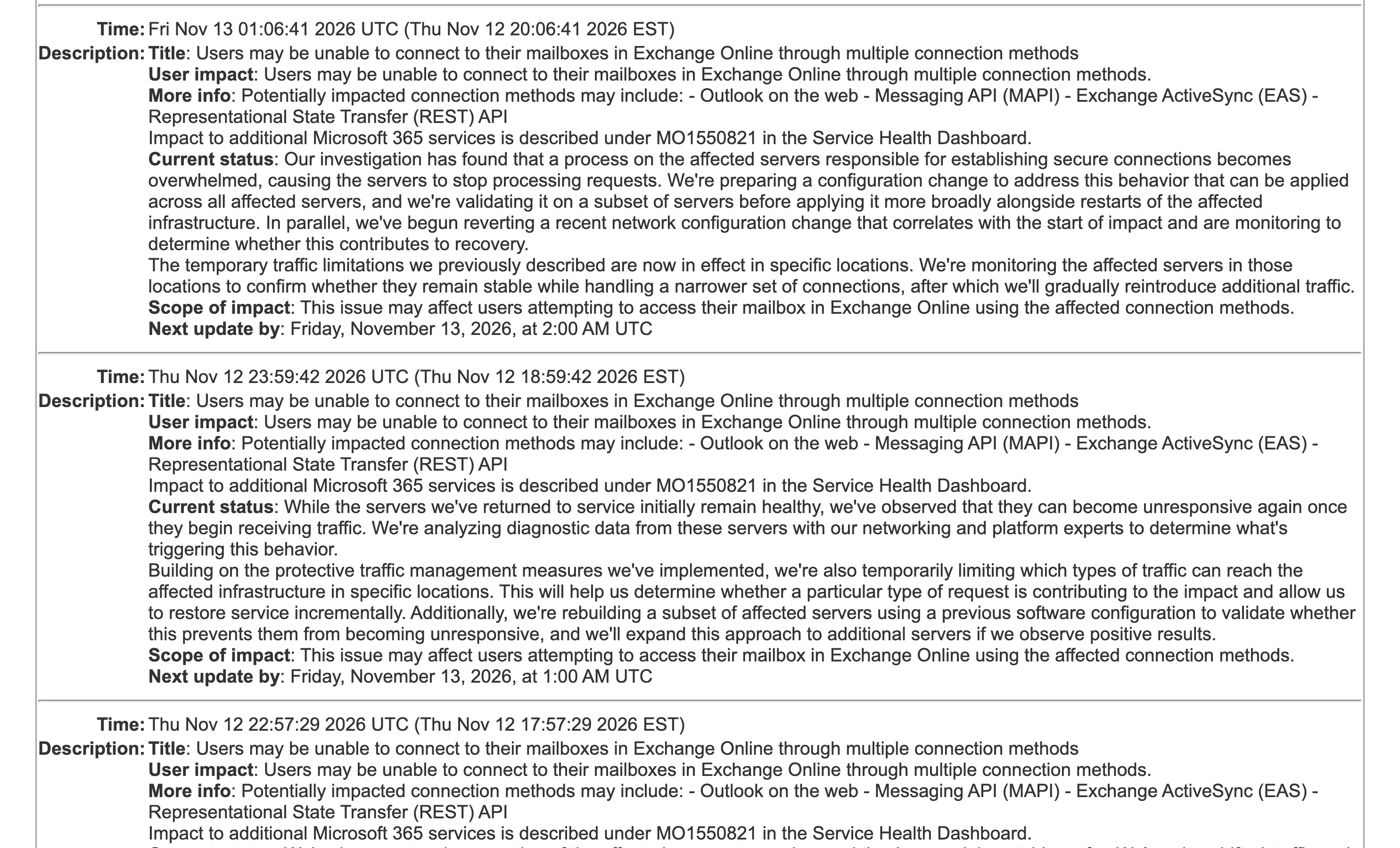
The 01:06 update names the overloaded connection process and a correlated network change. Captured on Penn’s copy of Microsoft’s tenant notices on 13 November 2026, 20:31 UTC.
Evidence: three Microsoft EX1550543 updates and the latest root-cause field
13 November 2026, 01:06:41 UTC
Our investigation has found that a process on the affected servers
responsible for establishing secure connections becomes overwhelmed,
causing the servers to stop processing requests.

In parallel, we've begun reverting a recent network configuration
change that correlates with the start of impact and are monitoring
to determine whether this contributes to recovery.

13 November 2026, 04:59:46 UTC
We’re continuing to observe heightened volume due to traffic
rebalancing actions that we have taken throughout this event.

However, we are encountering issues with the machines being stuck
in a bad state, preventing our changes from syncing as expected.

13 November 2026, 07:25:42 UTC
We’re seeing positive results for server stability after applying
an upstream authentication/routing configuration component patch
to a portion of our infrastructure.

Entry last updated: 13 November 2026, 20:02:19 UTC
Root Cause: N/A
Microsoft described the network change as correlated with the start of impact, while it directly attributed additional traffic volume to its rebalancing actions. We read the sequence as evidence that recovery actions also encountered capacity and configuration-propagation problems. It does not establish which change initiated the outage or identify a defective code path. Microsoft’s public status update (opens in a new tab) says a full post-incident report will follow mitigation.
The failed operation matters more than the app name
Microsoft’s incident record (opens in a new tab) divided Teams into operations with different outcomes. Joining calls and meetings, group chats and channel messages appeared among the core functions it said were unaffected. Calendar viewing, scheduling, invitations and meeting edits appeared among the failures. Creating or deleting private and shared channels could also fail, even though standard channels continued working. These are Microsoft’s reported conditions; we did not test an affected tenant ourselves.
That distinction follows a documented dependency. Microsoft’s Teams–Exchange troubleshooting guide (opens in a new tab) says the Teams Calendar app requires access to the user’s Exchange mailbox. It provides a separate connectivity test for the Teams backend’s ability to reach that mailbox.
We extracted the following operation-level split from Microsoft’s update:
| Operation | Microsoft’s reported condition at 20:02 UTC |
|---|---|
| Join a call or meeting | Listed among unaffected core functions |
| Use group chat or channel messages | Listed among unaffected core functions |
| View, schedule or edit calendar meetings | Failures |
| Create or delete private or shared channels | Could fail |
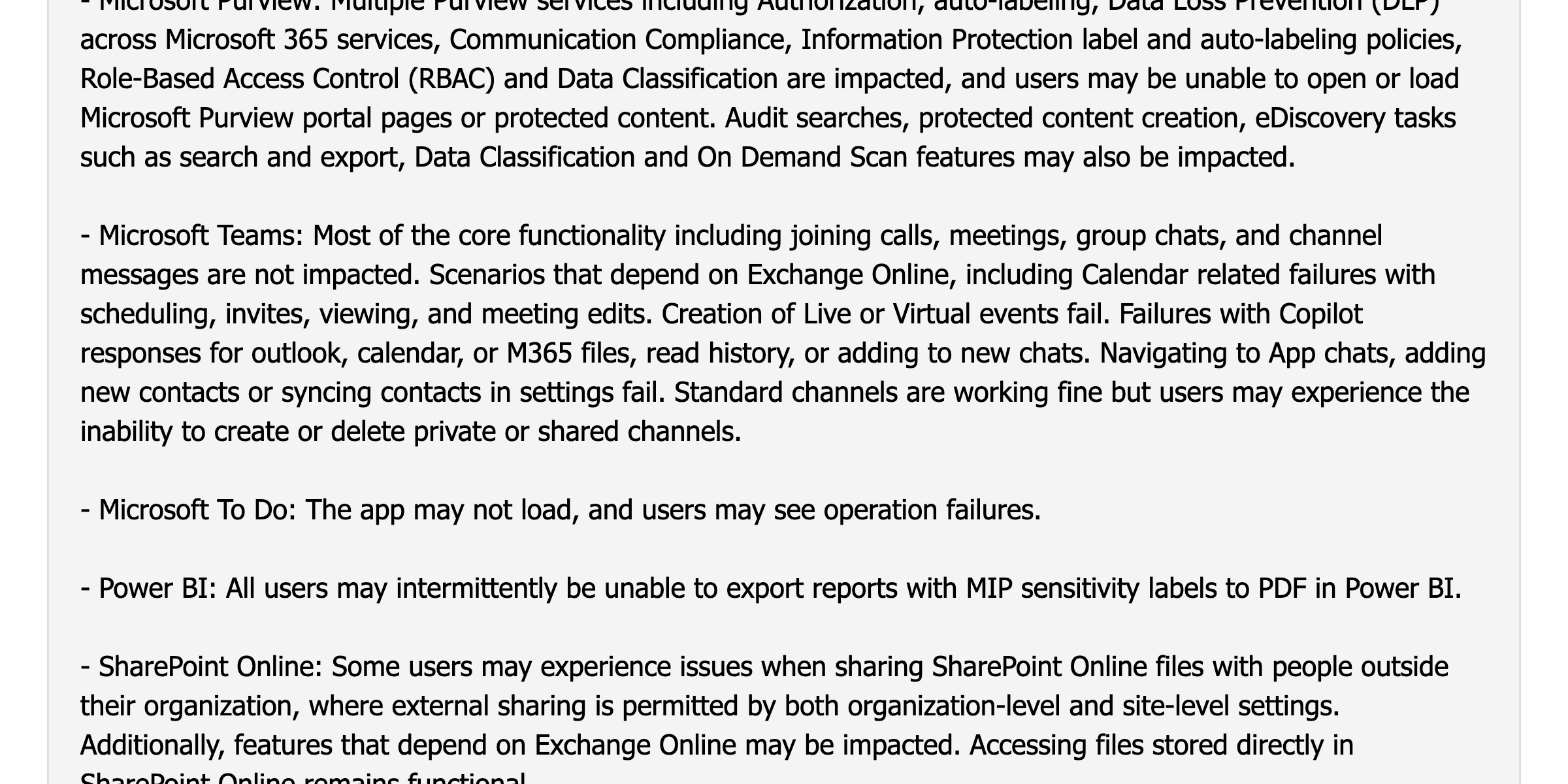
The Teams entry separates core functions from Exchange-dependent calendar scenarios. Captured on status.cloud.microsoft on 13 November 2026, 20:31 UTC.
Evidence: excerpts from one Microsoft status update, 13 November 2026
LastUpdatedTime: 2026-11-13T20:02:18+00:00
Status: Service degradation

Most of the core functionality including joining calls, meetings,
group chats, and channel messages are not impacted.

Scenarios that depend on Exchange Online, including Calendar related
failures with scheduling, invites, viewing, and meeting edits.

Standard channels are working fine but users may experience the
inability to create or delete private or shared channels.
At 17:52 UTC on 12 November, Anthropic reported (opens in a new tab) that requests to Teams chat and calendar through its Microsoft 365 connector could fail. Its 22:23 UTC update described failures for most mail, calendar and search requests and attributed them to the Microsoft incident.
Those reports concern a connector, whereas Microsoft’s Teams entry describes core application functions. They also come from different times. A connector’s failed chat request cannot establish that native Teams chat failed, and Microsoft’s statement about working chat cannot establish that every integration worked.
Exchange access extends beyond the Outlook window
Microsoft’s Exchange entry (opens in a new tab) listed mailbox-access problems through Outlook on the web, Outlook desktop using MAPI, Exchange ActiveSync and REST-based connections. It also warned of delayed email delivery. Switching from desktop Outlook to webmail therefore meant trying another connection method that Microsoft had already listed as affected, rather than a documented workaround.
The same record (opens in a new tab) described problems through Microsoft Graph. Requests accessing Exchange mail, calendar and contact data could time out, with consequences for Teams and channel management, membership, app management and activity notifications. A script managing a team and a person sending a channel message were separate operations in Microsoft’s account. We would preserve that distinction when investigating a failed automation instead of using a working chat window to dismiss its error.
Anthropic’s first update (opens in a new tab) included failed or slow connector requests and connections that might not complete. Later updates identified mail, calendar and search tools as failing for most requests. The operator also reported problems opening or using Claude for Outlook.
Evidence: two updates from one downstream operator, 12 November 2026
Anthropic incident: sqn3fg1l96dl

2026-11-12T17:52:45.043Z
We are investigating elevated errors and slow responses affecting the
Microsoft 365 connector. Requests to mail, SharePoint, Teams chat and
calendar through the connector may fail, and new connections to the
connector may not complete.

2026-11-12T22:23:58.309Z
This issue is caused by a Microsoft 365 service incident, and mail,
calendar and search tools in the Microsoft 365 connector are still
failing for most requests. Claude for Outlook remains affected.
We kept the operator’s phrase “most requests” rather than converting it into a percentage. Anthropic published no request count in these updates. Its first report establishes when it publicly described the symptoms, not when Microsoft’s outage began.
Calendar access requires a mailbox connection
Microsoft’s integration documentation (opens in a new tab) distinguishes Teams capabilities by the environment hosting a user’s mailbox. For Exchange Online Dedicated Legacy, for example, it lists chat and calling as available while meeting management is unavailable. This is a supported configuration with different capabilities, rather than an outage scenario.
The troubleshooting guide (opens in a new tab) identifies a more specific calendar requirement: access to the Exchange mailbox through Exchange Web Services. Its Teams Calendar App connectivity test checks whether the Teams backend can connect to the mailbox. The test asks the affected user to sign in, so reading the public status page cannot substitute for that tenant-level check.
The 01:06 Exchange update does not name EWS, TLS or a specific executable, so we cannot tie the overloaded connection process to this calendar path more precisely. The troubleshooting guide (opens in a new tab) also contains configuration remedies for calendar problems, including changes to EWS access policies. We would not apply those changes solely because this outage affected scheduling: the incident record (opens in a new tab) supplies no evidence that an affected tenant’s policy changed.
Recovery needs a calendar result
Microsoft’s 20:02 UTC update (opens in a new tab) still carried Service degradation. The company said infrastructure was stabilizing while it drained queued messages and rebalanced traffic, and that sign-in and access could improve before delivery and processing caught up. It gave no estimate for full recovery. The Exchange entry (opens in a new tab) had End Time: Not ended yet and Root Cause: N/A at 20:02 UTC.
For the Teams scheduling question, we would ask an affected user to record whether the calendar loads and whether a meeting can be created and subsequently edited. We would keep invitation delivery as a separate observation because Microsoft also reported delayed mail. The record should name the client or connector used, the operation, its result and the UTC time; a report from a different tenant would remain a separate observation.
If calendar access still failed, Microsoft’s Teams Calendar App test (opens in a new tab) would address the backend-to-mailbox connection specifically. Microsoft documents that test in its troubleshooting procedure (opens in a new tab), including its unavailability in GCC and GCC High environments.
Sources
All sources checked 13 November 2026. The incident excerpts preserve the versions read; the live status endpoints can change. Screenshots were captured on 13 November 2026 at the times in their captions; full-size originals and checksums are in the research notes.
- Microsoft, Users may be unable to connect to multiple Microsoft 365 services (opens in a new tab), updated 13 November 2026 at 20:02:18 UTC; public record
8699075d-35c0-49b1-8949-b505b6efeaca. Supports the Exchange, Teams and Graph impact descriptions, recovery state and pending post-incident report. The public status page (opens in a new tab) uses this endpoint; its RSS feed (opens in a new tab) repeated the same record and publication time, not an independent observation. - Microsoft Learn, How Exchange and Microsoft Teams interact (opens in a new tab), page dated 24 October 2023, metadata updated 4 February 2026; commit
8f9d46bcc6dc0ebcd9d34946a6a2e6529a4968ed. Supports the separation of meeting-management and calling capabilities by mailbox environment. - Microsoft Learn, Resolve interaction issues between Teams and Exchange Server (opens in a new tab), page dated 22 November 2024, metadata updated 9 November 2026; commit
b8560a9c3e34a8e9ad41c096bf1ca48ddcc45452. Supports the calendar’s mailbox dependency, configuration checks and authenticated connectivity test. - Anthropic, Elevated errors affecting the Microsoft 365 connector (opens in a new tab), incident
sqn3fg1l96dl, updates of 12 November 2026 at 17:52–22:23 UTC; timestamps cross-checked against its incident API (opens in a new tab). Supports downstream connector and Outlook add-in symptoms, reported by the affected operator. - Microsoft, Microsoft’s Incident Report for PennO365 (opens in a new tab), republished by the University of Pennsylvania; extract generated 13 November 2026 at 20:20 UTC, EX1550543 last updated at 20:02:19 UTC. Supports the incident IDs, preliminary connection-process findings, mitigation sequence and unfilled root-cause field. Penn republishes Microsoft’s tenant notices; it is not an independent observer of the server mechanism.


