

Binance's RCA: access path disclosed, signing approval unexplained
Overview
Binance's 3 November report traces the attack from a fake job interview to its wallet signing service. The reproduced Ethereum delegation matches it; why the signing service signed 50 EIP-7702 authorizations is still unexplained.
By the Maborak Engineering Team
Binance’s root-cause analysis of the 29 October 2026 incident is incomplete. Public chain data shows valid signatures from a Binance hot-wallet authority installing EIP-7702 code delegation, followed by a sweep sent from a different account. No public source explains how the attacker obtained those signatures, or how the possible laptop and container entry point that Binance described leads to them. The company estimates the total impact at around $6.3B. [vendor] (Binance (opens in a new tab)); [reproduced] (delegation (opens in a new tab))
Checked 30 October 2026. Latest source retrieval: 14:52:07.873 UTC. Later disclosures are not covered. Labels: [vendor] for statements by Binance and Richard Teng, its co-CEO; [reproduced] for read-only RPC queries and offline signature checks run for this note; [inferred] for analysis. Researcher findings are attributed by name. No endpoint, container or signer forensics were available.
Updates, newest first
Update, 4 November 2026, 22:50 UTC
Binance has now described the access path. On 3 November it published “29 October 2026 Binance Security Incident: Initial Findings and Response Update” on its blog (opens in a new tab) and as an X Article (opens in a new tab) posted at 14:33:06 UTC. The blog blocks automated requests, so its text was read from the Internet Archive’s capture at 16:05:59 UTC (opens in a new tab); a second capture, at 13:35:03 UTC on 4 November, has the same text, and so does the X Article. Binance calls it “our initial report” and says its findings “will be subject to further independent review”. [vendor]
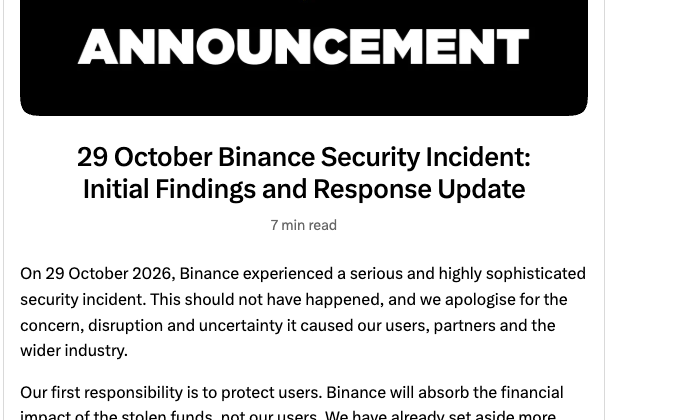
The X Article, posted at 14:33:06 UTC on 3 November 2026; screenshot taken on 4 November.
The report answers the question this article was written around, at the level of detail Binance chose to publish: “The attacker exploited unauthorized access to an internal wallet signing service to initiate transactions outside the normal withdrawal process.” Later it adds: “The attacker then used the signing service to exploit Ethereum’s EIP-7702 authorization mechanism.” The explanation TRM and Elliptic called most likely, in the section “Signer-service compromise is an assessment” below, is now the company’s own account. It is still a company account: no logs, hosts or signer records were published. [vendor]
The path, as Binance tells it. [vendor]
| When | What the report says |
|---|---|
| June 2026 | “Engineer A from Wallet DevOps downloaded a tampered Homebrew installation in order to install a popular AI coding tool.” Binance replaced the device and “rotated all related credentials”, but Engineer A’s role and his colleagues on the wallet infrastructure team were “exposed to the hacker”. |
| September 2026 | Software Engineer B was approached on “a legitimate job-hunting platform” by someone posing as a Project Director, had a live video interview with a purported HR representative and a second interview “in a popular social chat app”, and was told to download an “assignment” repository “onto his work computer”. Its setup code replaced /opt/homebrew/Cellar/pyenv/2.8.0/libexec/pyenv (3,344 bytes) with a 3,414-byte version and spawned zsh. Binance calls it “0-day malware” that endpoint tools did not detect. |
| 20 October | The attacker “leveraged the compromised computer of engineer B and used an internal AI tool to gain control over” Engineer A and Wallet Software Engineer C, and found that Engineer A “had a container deployment permission token on his computer”. |
| 29 October, “between 17:15 and 19:56” | The attacker “logged onto Software Engineer C’s computer, used the credentials stolen from Wallet DevOps Engineer A, deployed a container, and triggered a malicious script to launch the attack.” |
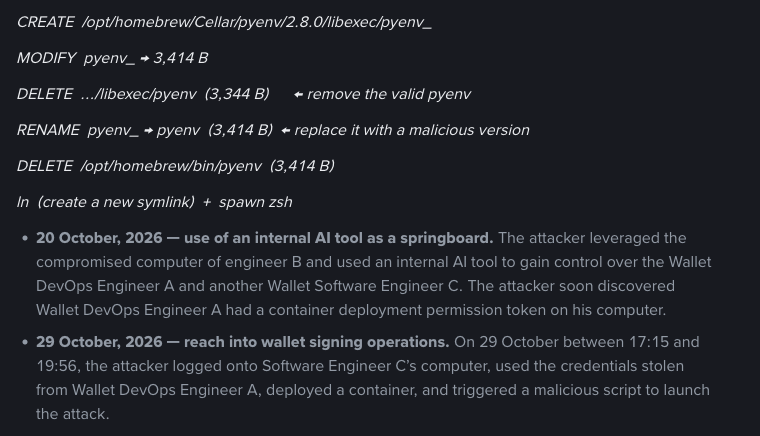
Binance’s blog, Internet Archive capture of 3 November 2026, 16:05:59 UTC.
The report gives no time zone for “17:15 and 19:56”, although it marks its other times as UTC. If they are UTC, the script was running nine minutes before the first outflow, which the report puts at 20:05 UTC on the XRP Ledger, and 25 minutes before the delegation was installed on Ethereum at 20:20:59. [inferred]
How the report compares with the chain data reproduced here. Three points agree; one sentence is worded differently from what the chain shows.
- Order. The report lists XRP from 20:05 to 20:09 UTC, then Solana and Optimism, an internal alert, 18,270 BTC, and only “then” the EIP-7702 delegation. That agrees with TRM’s first row in the timeline below and with the delegation at 20:20:59.
[vendor];[reproduced] - Revocation. “At 00:10 UTC on 30 October 2026, Binance executed a new authorization from the Binance14 hot wallet to the zero address, clearing the EIP-7702 delegation code.” The clearing transaction reproduced below took effect at 00:10:35 UTC, block 26,301,896.
[vendor];[reproduced] - Mechanism. The report describes EIP-7702 correctly: it “allows an account to delegate certain execution rights to a smart contract without exposing the private key.” Teng’s 30 October transcript had called it “a known multi-signature protocol”.
[vendor] - “50 signing transactions.” The report says “The attackers submitted 50 signing transactions to manipulate the account nonce and establish malicious delegation authorizations.” On chain there is one transaction,
0xad9926…1298b(opens in a new tab), carrying 50 authorizations, all signed by the hot wallet, for nonces 18,914,775 to 18,914,824; only the one for 18,914,809 matched the wallet’s nonce and took effect. Read as 50 signing operations, the sentence fits: signing a range of nonces makes one of them valid whenever the transaction lands. Read as 50 transactions, it does not match the chain.[reproduced];[inferred]
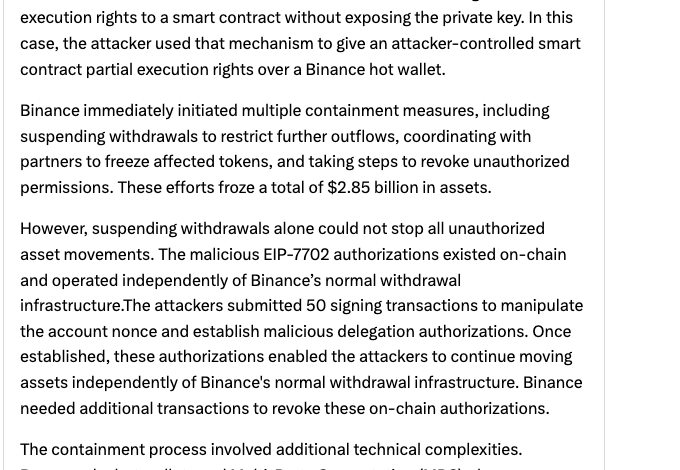
The report also explains why clearing the delegation took until 00:10: “Because the hot wallet used Multi-Party Computation (MPC), there was no single private key that could be used to immediately revoke the malicious EIP-7702 authorizations,” so the team “developed and executed a specialized procedure”. It puts the last unauthorized transfer, 2,961.9 ETH, at 23:56 UTC, from a transaction that “had previously been broadcast and remained pending”. That transfer was not reproduced here. [vendor]
What the report leaves out. The open question has moved from how the attacker got in to why the signing service signed. Not disclosed:
- How the script in the attacker’s container authenticated to the signing service, and what the service checked before signing. Binance says it is “reviewing the incident response process, signing policy coverage, hot wallet controls”, which suggests the signing policy did not cover this request; the report does not say so.
[inferred] - Why the service signed 50 EIP-7702 authorizations for nonces the wallet had not yet reached, and whether that kind of request had any approval step at all.
- Which MPC participants took part, and whether the threshold approval ran as designed. The report says nothing about key material; the earlier “We have found no evidence of any wallet private key leak” is not repeated.
- What the internal AI tool is, and how it gave the attacker control of two more engineers’ computers.
- Why Engineer A held a container deployment token in October after “all related credentials” were rotated in June, and what that token allowed.
- How this account relates to the first statement on 30 October, “a compromised DevOps engineer’s laptop, which allowed an attacker to gain access to a service container”. The report has the attacker deploying a container from Engineer C’s computer with Engineer A’s credentials.
- Who the reviewers are: “We are engaging independent security firms for further review.” None is named, and no date is given.
Teng’s “self-destruct mechanism” now reads differently: the report says the malware on Engineer B’s computer took “steps to conceal the malicious activity and remove traces of the compromise”. [vendor]
Later than promised. Update #2, posted at 19:58 UTC on 30 October, promised “further technical findings within about 48 hours”, due at about 19:58 UTC on 1 November. The report was posted 42 hours 35 minutes after that. [vendor]; [inferred]
Money and reserves. The report puts the impact at “approximately USD 6.34 billion”, up from “approximately $6.3B”, with “approximately USD 2.85 billion” “frozen or intercepted, subject to reconciliation and market price volatility”, and says that “As of 31 October 2026, 98% of the impacted token assets have been replenished”. Recovery Update #6 (opens in a new tab), published at 02:40 UTC on 3 November, reopened withdrawals for more assets. Recovery Update #7 (opens in a new tab), an X Article posted at 15:26:23 UTC on 4 November, repeats “approximately 98%” and reports a Proof of Reserves snapshot at 00:00 UTC on 4 November covering “44 tokens, up from 10”; generating its zero-knowledge proof “is expected to take approximately 50 to 60 hours”. The replenishment is Binance’s own money, not funds recovered from the attacker. Whether the zero-knowledge proof for the 31 October snapshot was published was not checked. [vendor]
Attribution and tracing. The report makes no attribution of its own; it links the FBI alert covered in the 1 November update and says the FBI “indicates that the Democratic People’s Republic of Korea is responsible for this incident.” North Korea rejected the attribution. Through state media, Kim Yo Jong called it “absurd rhetoric and nothing new” and “a grave political provocation against the DPRK”, as quoted by ABC News (opens in a new tab) from Reuters on 3 November; the original state-media text was not read. Two tracing firms published on 3 November. Elliptic (opens in a new tab), last updated at 09:15 UTC on 4 November, counts “about 12,000 wallets across 11 blockchains” and “more than 40,000 transactions” in the first three and a half days, and says “Around $3.21 billion remains in addresses linked to the theft, mostly as ETH and BTC.” TRM (opens in a new tab) puts the attacker’s remaining ETH and BTC at “about USD 2.4 billion”, the same figure as its 30 October post, and describes a self-minted token on Tron whose pool was “funded … with stolen proceeds”. The two firms count different things at different times, so their figures cannot be compared. Elliptic also puts the theft at $6.43 billion; some coverage of Binance’s report uses that number, while Binance’s is $6.34 billion. None of these figures was reproduced here.
What the coverage adds on the mechanism. Nothing that Binance did not publish. Halborn (opens in a new tab) reaches the same open question as this update: “Whether the service authenticated the caller at all, whether it trusted anything inside its network segment, or whether the stolen token itself carried that right, is not stated.” SecurityWeek (opens in a new tab) notes that “The report does not explain how the AI tool was used.” No source checked names the independent firms, gives an MPC threshold or participant count, or describes how the signing service authorized its caller.
Update, 1 November 2026, 14:00 UTC
Withdrawals came back in the order Binance’s own timetable predicted. Binance published Recovery Update #4, “Withdrawals Resume in Phases”, on its support site (opens in a new tab) at 04:08 UTC on 1 November and as an X Article (opens in a new tab). It set a first phase of withdrawals for 06:00 to 09:00 UTC that day. The support site still answers automated requests with a bot challenge, so its text was read from the Internet Archive’s capture at 09:15 UTC (opens in a new tab). [vendor]
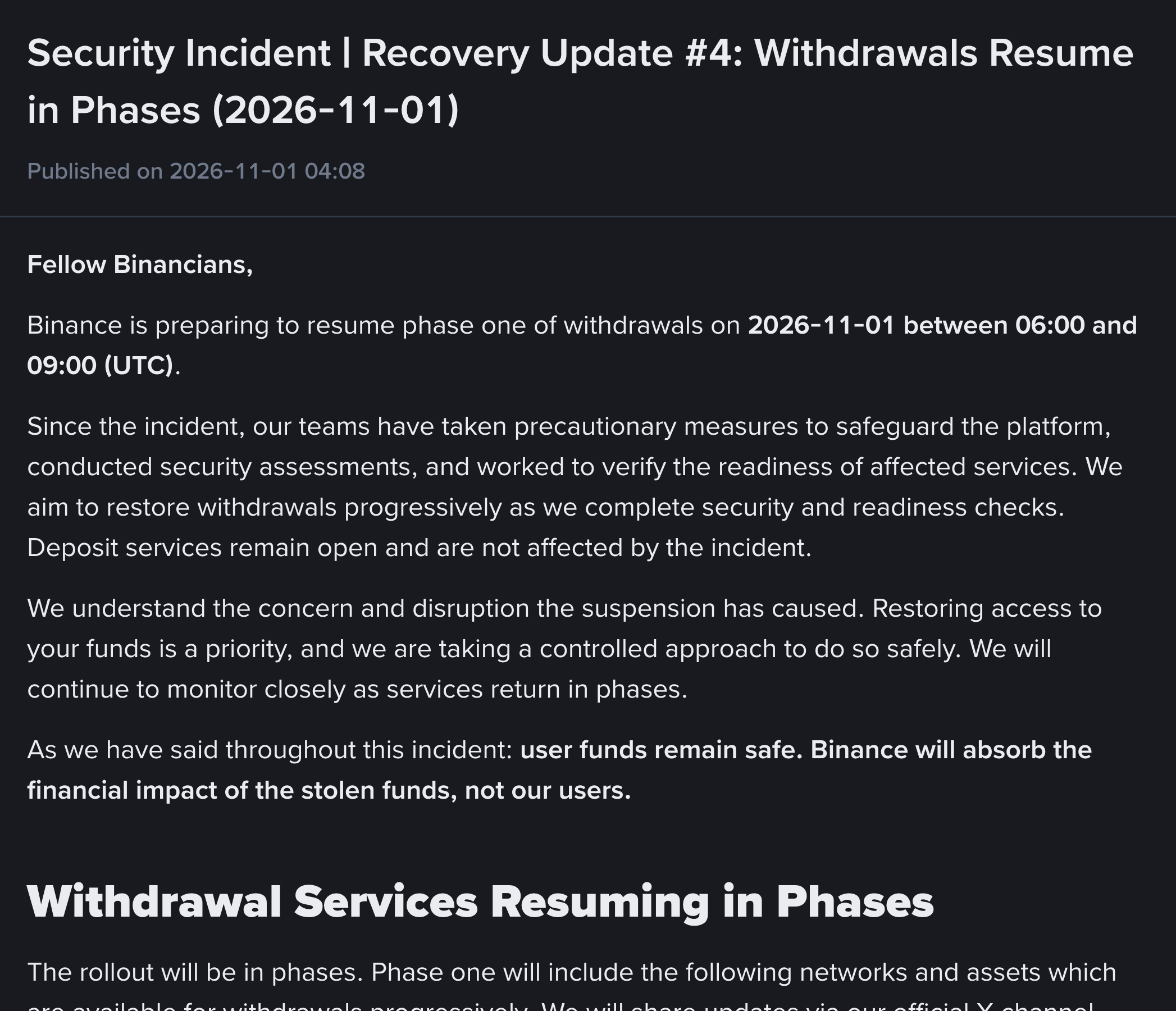
Recovery Update #4 in the Internet Archive’s capture of 1 November 2026, 09:15 UTC; screenshot taken at 13:48 UTC.
Binance announced Bitcoin as the first network opened in a post whose embed carries the timestamp 06:20:36 UTC, which X labels “Last edited”. Ethereum and BSC followed: a second post, timestamped 07:49:25 UTC, lists USDC, USDT and ETH on Ethereum and USDC, USDT and BNB on BSC as restored. [vendor] (BTC (opens in a new tab), ETH and BSC (opens in a new tab))
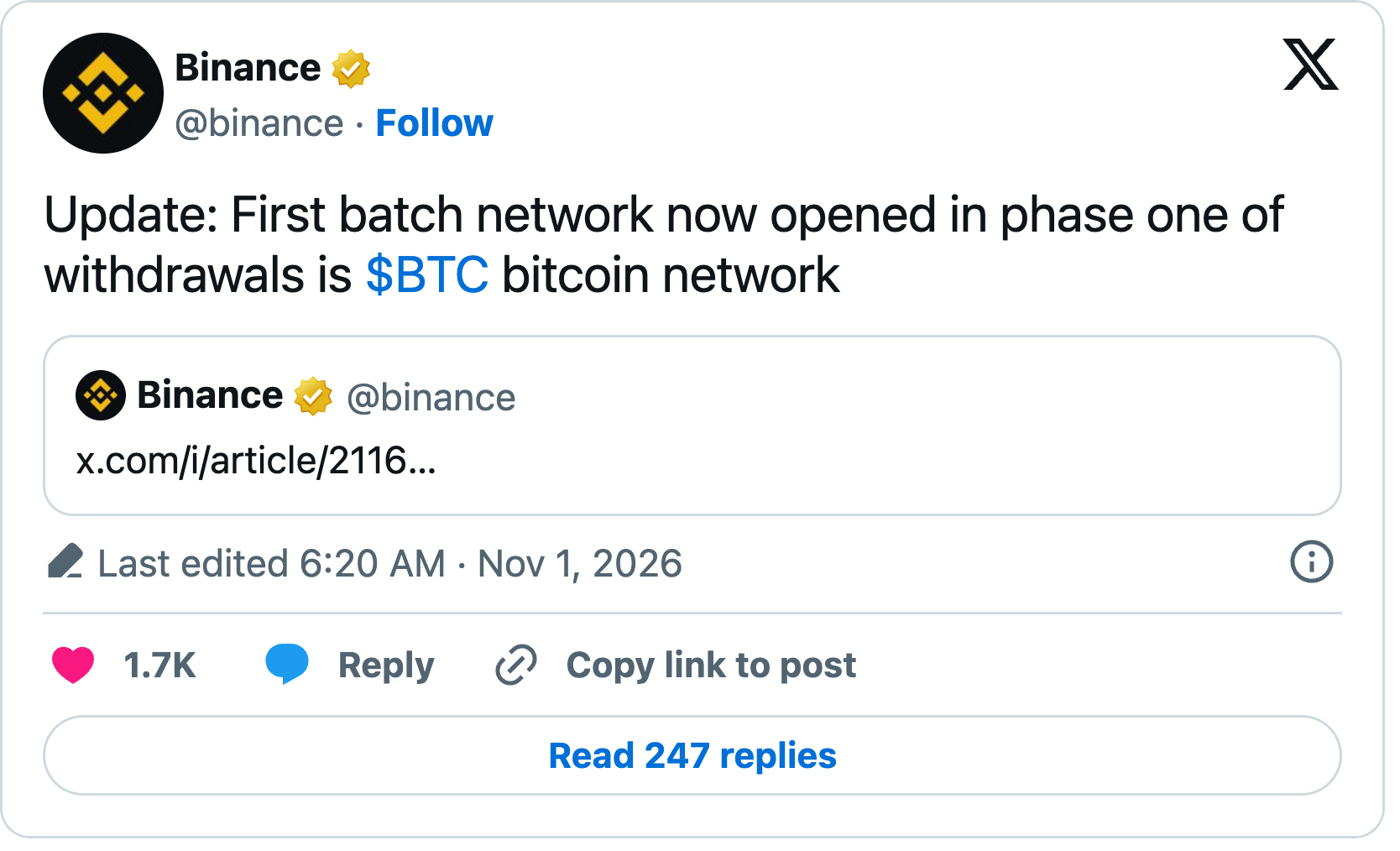
Binance’s post as rendered by X’s official embed, captured 1 November 2026 at 13:49 UTC.
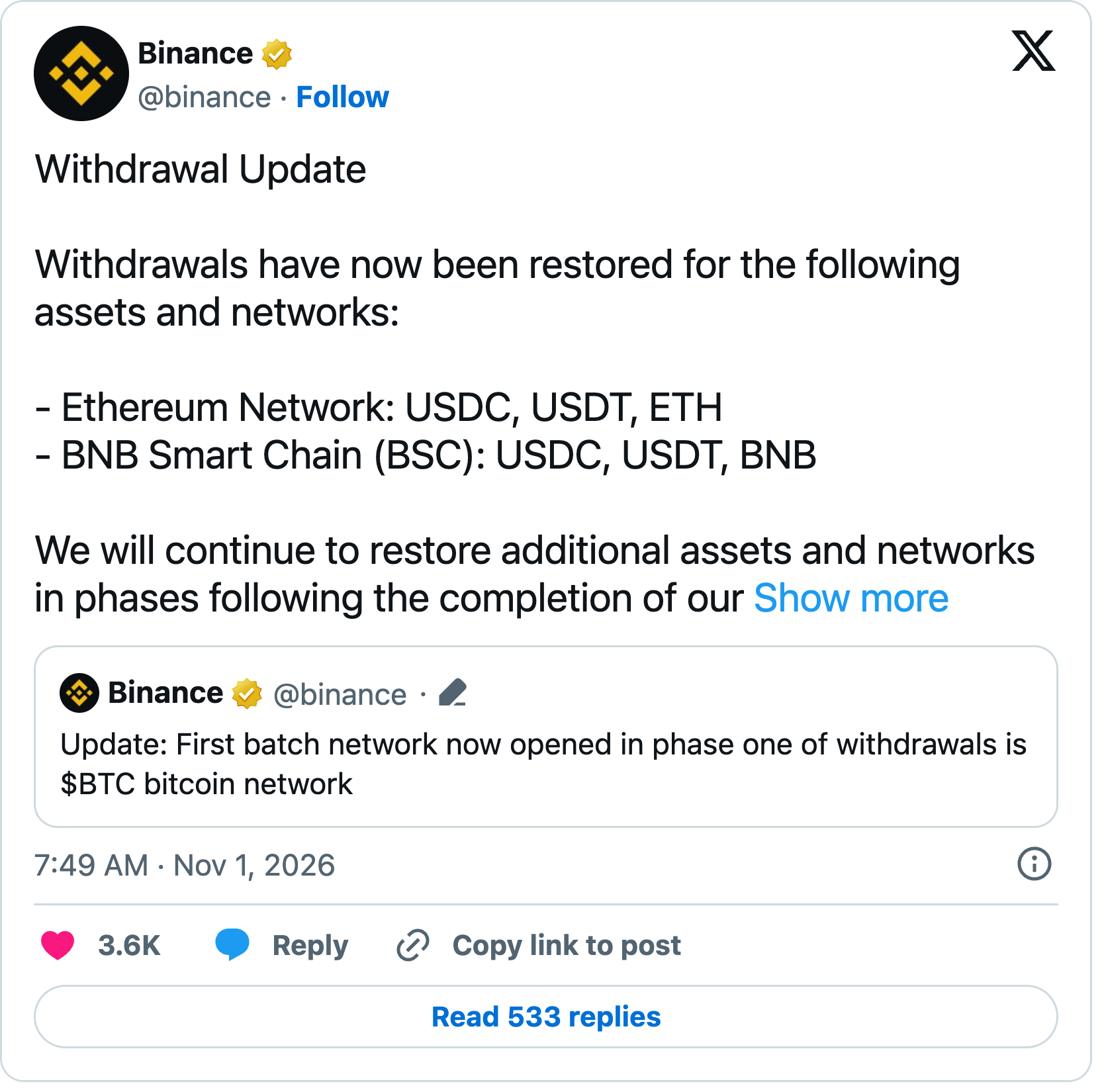
The second post, as rendered by X’s official embed, captured 1 November 2026 at 13:49 UTC.
Phase one names fifteen networks, with selected assets on each. Binance says deposit services “remain open and are not affected by the incident”. [vendor]
| Network | Assets listed for phase one |
|---|---|
| BTC | BTC |
| ETH | ETH, USDT, USDC |
| BSC | BNB, USDT, USDC |
| TRX | TRX, USDT |
| SOL | SOL, USDT, USDC |
| XRP | XRP |
| ZEC | ZEC |
| DOGE | DOGE |
| TON | USDT, GRAM |
| MATIC (Polygon) | POL, USDT, USDC |
| AVAXC | AVAX, USDT, USDC |
| ARBITRUM | ETH, USDT, USDC, ARB |
| BASE | ETH, USDC |
| OP (Optimism) | ETH, USDT, USDC |
| SUI | SUI |
The money. Covered is “approximately 95% of the impacted amount, up from 90% in our prior update”. The outstanding 5% are “tokens outside the top ten listed above”, which “are less liquid in the market and take longer time to source at the required scale”. All ten named assets are “fully backed 100%”. Update #4 gives no new funding breakdown; Update #3 named a partial SAFU deployment, part of the Futures insurance fund, and corporate treasury. [vendor]
New reserve addresses. At 06:53:51 UTC, Binance posted (opens in a new tab) that it had “updated our list of Proof of Reserves addresses to include newly generated wallet addresses”, and that “all withdrawals will be processed from these new wallet addresses”. [vendor]
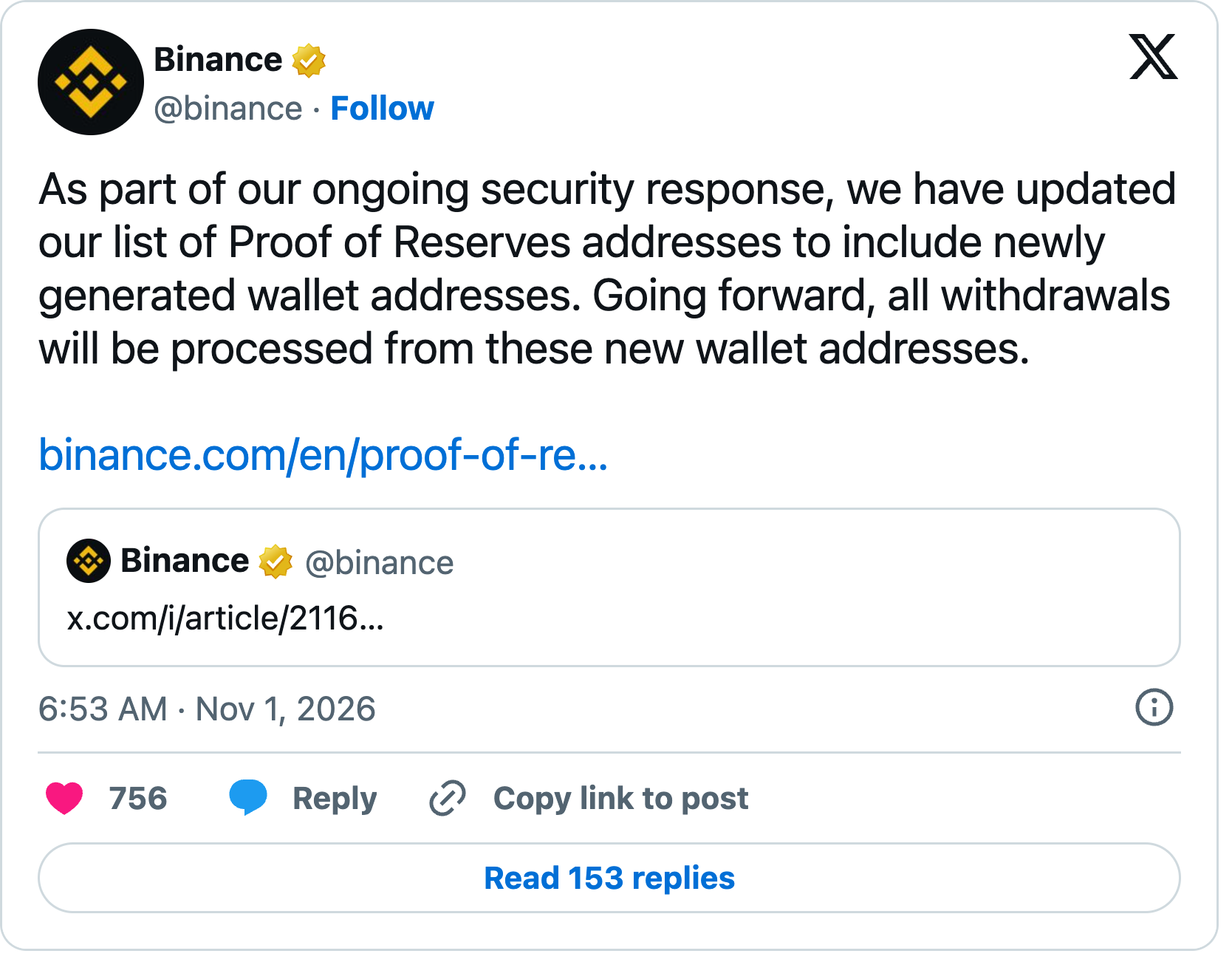
Binance’s post as rendered by X’s official embed, captured 1 November 2026 at 13:49 UTC.
The cryptographic half of that is still outstanding. Update #3 put the zero-knowledge proof at “by Tuesday, 2026-11-03 (UTC)”. Some accounts circulating online give Monday 2 November for it; that date belongs to Update #2’s Proof of Reserves snapshot deadline, which was met with a snapshot taken at 00:00 UTC on 31 October. [vendor]; [inferred]
The FBI attributed the theft to North Korea. On 31 October the FBI published the cyber alert “North Korea Responsible for $6 Billion+ Binance Attack”. It says the Democratic People’s Republic of Korea “was responsible for the theft of more than $6 billion USD in virtual assets from cryptocurrency exchange Binance, on or about October 29, 2026”, and refers to the activity as “TraderTraitor”. The bureau, “together with partners at the USSS and IRS-CI”, says it “has observed TraderTraitor actors converting stolen assets primarily into Ethereum (ETH)” and expects further laundering “using DeFi and instant swap services”. It urged THORNode operators, RPC node operators, instant exchanges, DeFi services, blockchain analytics firms and other virtual asset service providers to block the addresses it lists. [vendor] (alert (opens in a new tab))
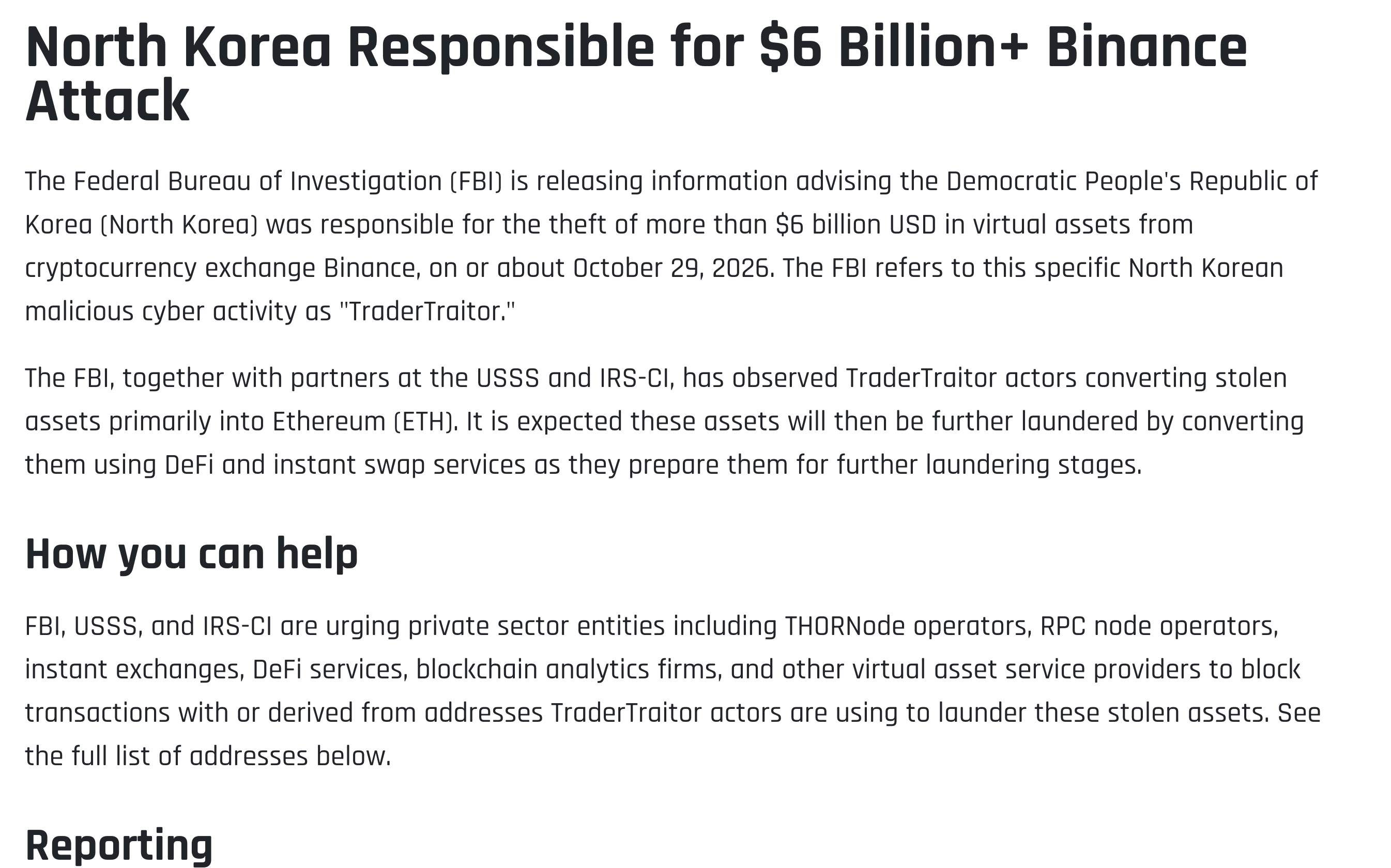
The FBI alert in the Internet Archive’s capture of 1 November 2026, 09:32 UTC; screenshot taken at 13:50 UTC.
The alert publishes 628 addresses: 608 Ethereum, 19 Bitcoin and 1 Solana. That is a count of the alert’s own text, where every string matches its chain’s address format and none repeats. [reproduced]
This is the first attribution by a government. It supersedes the line in the update below, written on 31 October, that “No government has yet confirmed attribution.” Binance’s own updates still name no attacker. [inferred]
The attribution is not publicly unanimous within the US government. Asked about the case on 31 October, President Donald Trump said: “I’m not concerned. We’re learning about it,” and “We don’t know if it’s North Korea”, while allowing that it could still be confirmed. [reported] (AP report (opens in a new tab))
Still no technical finding. Update #4 is about money and access to it. It says nothing about how the wallet-authority signatures were obtained, which approval control the delegation avoided, what the “additional points of breach” were, or the self-destruct claim. Its only line on the mechanism is forward-looking: “Once the investigation is complete, we will publish a post-incident report with further details on the incident.” [vendor]
| Binance’s wording | Due, counted from its own post | What happened |
|---|---|---|
| Withdrawals “within approximately 34 hours” (Update #2) | about 05:58 UTC, 1 Nov | BTC opened 06:20:36 UTC; ETH and BSC by 07:49:25 UTC |
| Proof of Reserves snapshot “in 12 hours”, result “by Monday 2026-11-02” (Update #2) | 31 Oct | Snapshot taken 00:00 UTC 31 Oct and published; see Update #3 |
| Zero-knowledge proof “approximately 40 to 50 hours” (Update #3, 15:23 UTC 31 Oct) | “by Tuesday, 2026-11-03 (UTC)” | Pending |
| “Further technical findings within about 48 hours” (Update #2) | about 19:58 UTC, 1 Nov | Not published as of 14:00 UTC |
[vendor]; [inferred] for the arithmetic
The last row is the one that matters here. Counted from Update #2’s 19:58 UTC post on 30 October, the technical findings it promised fall due at about 19:58 UTC today and have not appeared. Update #3 and Update #4 do not repeat the commitment; both replace it with a report that follows the investigation. The withdrawal estimate from the same update did hold: “within approximately 34 hours” of 19:58 UTC pointed to about 05:58 UTC, and Bitcoin opened at 06:20:36 UTC. Binance can therefore move funds on a stated schedule; it has not yet explained how the signatures were obtained. [vendor]; [inferred]
No new chain evidence was published by Binance today, and the reproduced path in the body below is unchanged. [inferred]
Update, 31 October 2026, 18:53 UTC
Binance published Recovery Update #3 on its support site (opens in a new tab), labelled “Published on 2026-10-31 14:24” and “Updated on 2026-10-31 15:23”, and as an X Article (opens in a new tab) at 14:30 UTC. The support site still blocks automated requests, so the text was read from the Internet Archive’s capture at 16:34 UTC (opens in a new tab). [vendor]
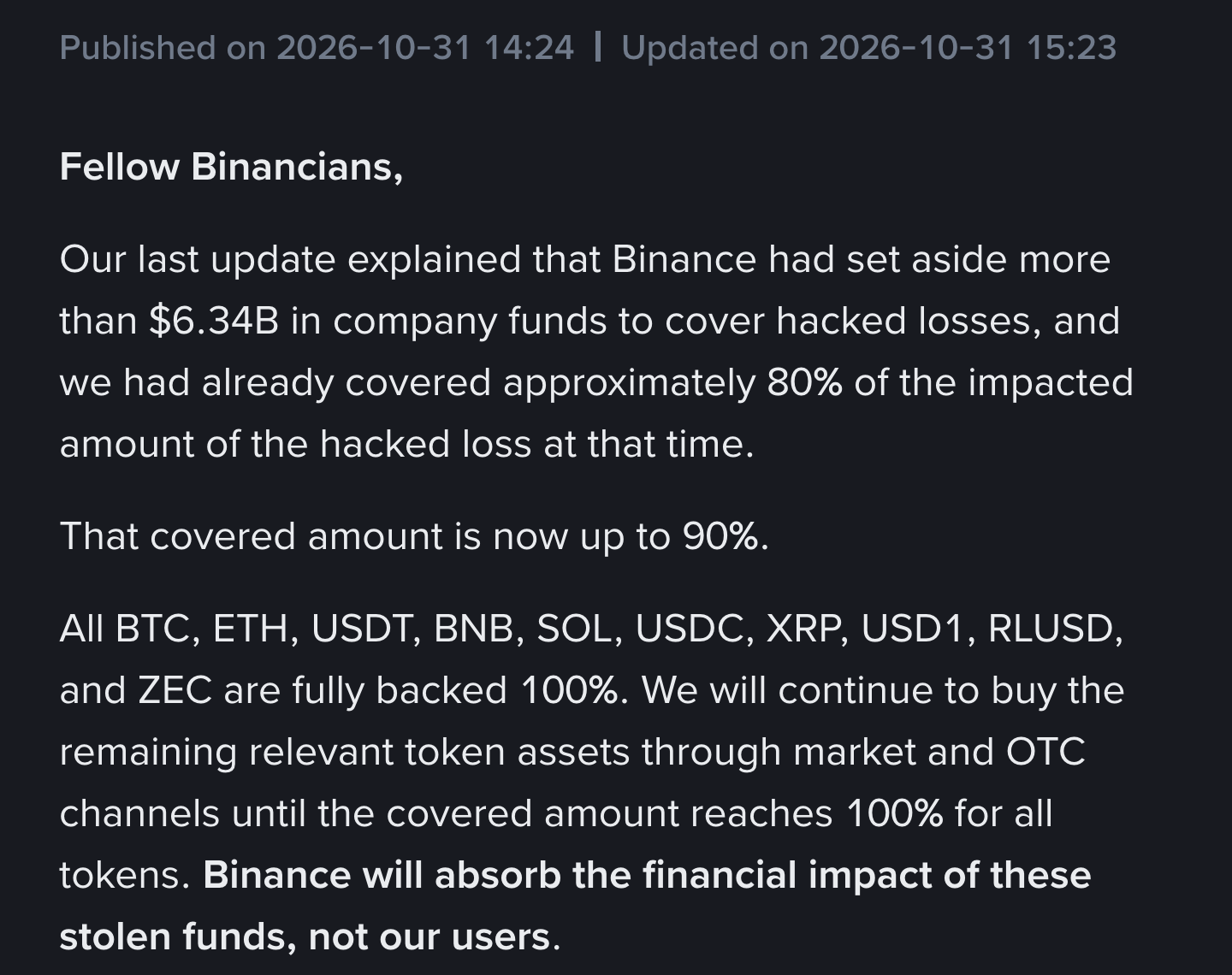
Recovery Update #3 in the Internet Archive’s capture of 31 October 2026, 16:34 UTC; screenshot taken at 18:42 UTC.
Still no technical finding. Update #3 is about money. It says nothing about how the attack worked, how the wallet-authority signatures were obtained or what the “additional points of breach” were. The technical findings promised in Update #2 “within about 48 hours” fall due at about 19:58 UTC on 1 November. [vendor]; [inferred]
What changed since Update #2. [vendor]
| Item | Update #2 (30 Oct) | Update #3 (31 Oct) |
|---|---|---|
| Covered | “approximately 80% of the impacted amount” | “now up to 90%”; “All BTC, ETH, USDT, BNB, SOL, USDC, XRP, USD1, RLUSD, and ZEC are fully backed 100%” |
| Still missing | Bought “through market and OTC channels” | “tokens outside the top ten”, which “are less liquid” and “may take longer to source” |
| Who pays | SAFU “and our corporate treasury” | “A partial deployment” of SAFU, “A portion of our Futures insurance fund” and “Binance’s own corporate treasury” |
| Proof of Reserves | Snapshot “in 12 hours”, results “by Monday 2026-11-02” | Snapshot “at 2026-10-31 00:00 (UTC)”, already on the reserves site; the full zero-knowledge proof takes “approximately 40 to 50 hours”, estimated “by Tuesday, 2026-11-03 (UTC)” |
| Withdrawals | “within approximately 34 hours” | “on track to reopen withdrawals” on “Sunday, 2026-11-01” |
The Futures insurance fund is new as a source of money. Binance says only an excess above the required level was used. The result users can check themselves has moved from Monday to Tuesday. [inferred]
The SAFU transfer, on-chain. Update #3 gives the SAFU fund’s Bitcoin address as 1BAuq7Vho2CEkVkUxbfU26LhwQjbCmWQkD. At 16:15 UTC, Binance posted (opens in a new tab) that the “SAFU fund transfer is complete” and linked the transaction. Querying the address through the public mempool.space API shows two outgoing transfers that afternoon, both to 165EurvYDfNNYFQCtdT6LEPJrCeX3SMmee: [reproduced]
| UTC | Block | Amount | Transaction |
|---|---|---|---|
| 31 Oct, 14:45:31 | 973,983 | 1 BTC | 457eea…1c93 (opens in a new tab) |
| 31 Oct, 14:51:41 | 973,984 | 7,499 BTC | 774fcb…14bd (opens in a new tab) |
The address kept 7,500.00136678 BTC, so the transfer moved about half of its Bitcoin. Binance has not said who controls the receiving address or which stolen balances the bitcoin replaces. Read in that order, it looks like a 1 BTC test followed by the main transfer six minutes later. [reproduced]; [inferred]
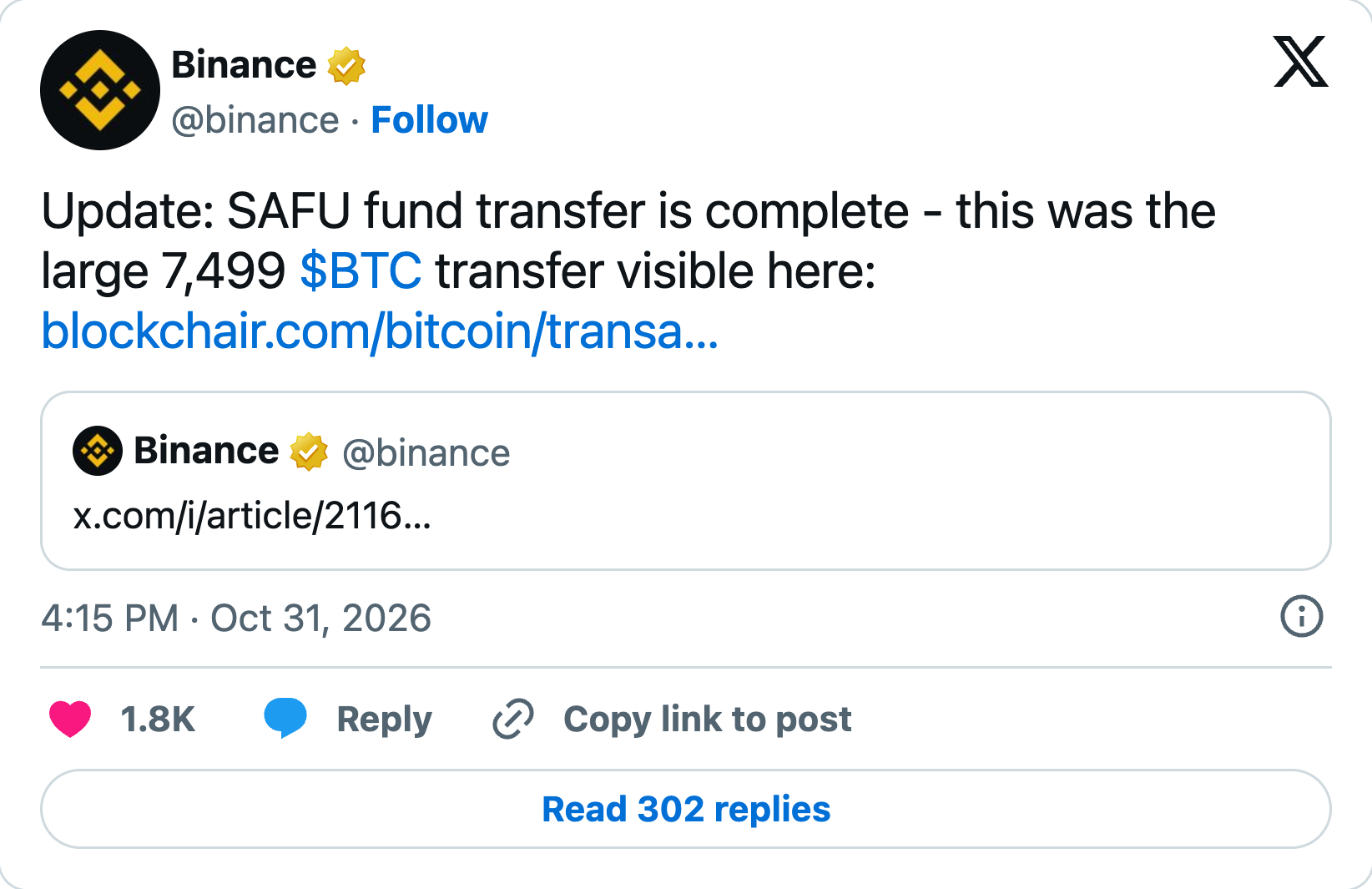
Binance’s post as rendered by X’s official embed, captured 31 October 2026 at 18:40 UTC.
# Read-only: the SAFU address's recent transactions and balance (public mempool.space API)
A=1BAuq7Vho2CEkVkUxbfU26LhwQjbCmWQkD
curl -s https://mempool.space/api/address/$A/txs | jq -r --arg a "$A" '.[] |
  [(.status.block_time | todate), .txid[0:12],
   (([.vout[] | select(.scriptpubkey_address == $a) | .value] | add // 0)
    - ([.vin[] | select(.prevout.scriptpubkey_address == $a) | .prevout.value] | add // 0)) / 1e8]
  | @tsv' | head -5
curl -s https://mempool.space/api/address/$A | jq '(.chain_stats.funded_txo_sum - .chain_stats.spent_txo_sum) / 1e8'
Attribution. Two more blockchain-analysis firms now name North Korea. Elliptic (opens in a new tab), last updated at 05:00 UTC on 31 October, says it is “likely” that TraderTraitor carried out the theft and that some funds were “laundered alongside proceeds of the Bitget exploit”. Chainalysis (opens in a new tab) “attributes the hack to TraderTraitor”, citing Binance funds “commingling” with Bitget funds. Elliptic adds that “No government has yet confirmed attribution.” Binance’s own updates still name no attacker. Neither firm’s attribution was reproduced here.
Law enforcement. The US Secret Service told reporters on 30 October that it is “working around the clock” with private-sector partners “to identify, freeze, trace, and recover funds”, together with the US Attorney’s Office for the District of Columbia. The FBI said it is “aware of the incident”. Neither statement appears on the agencies’ own websites or X accounts; the quotes come from the BBC (opens in a new tab). [reported]
Freezes and Aave. Elliptic says it has verified $2.85 billion frozen or seized on-chain, 44% of the theft, as of about 04:30 UTC on 31 October. It names freezes by Tether, Circle, Ripple, World Liberty Financial, Paxos and First Digital, Tether freezing tokenised gold and Binance freezing its own WBETH. On Aave, its risk provider LlamaRisk (opens in a new tab) reports that one attacker wallet supplied 60M USDT and borrowed 19,762 WETH, about $44.6M, between 20:58 and 21:01 UTC on 29 October. Aave’s guardians then froze all Aave markets on every network between 21:42 and 23:04 UTC, not only the stolen tokens; LlamaRisk’s 13:49 UTC update on 30 October describes the staged unfreeze. Elliptic reports the loan still open on 31 October. None of these figures was reproduced here.
Update, 31 October 2026, 02:20 UTC
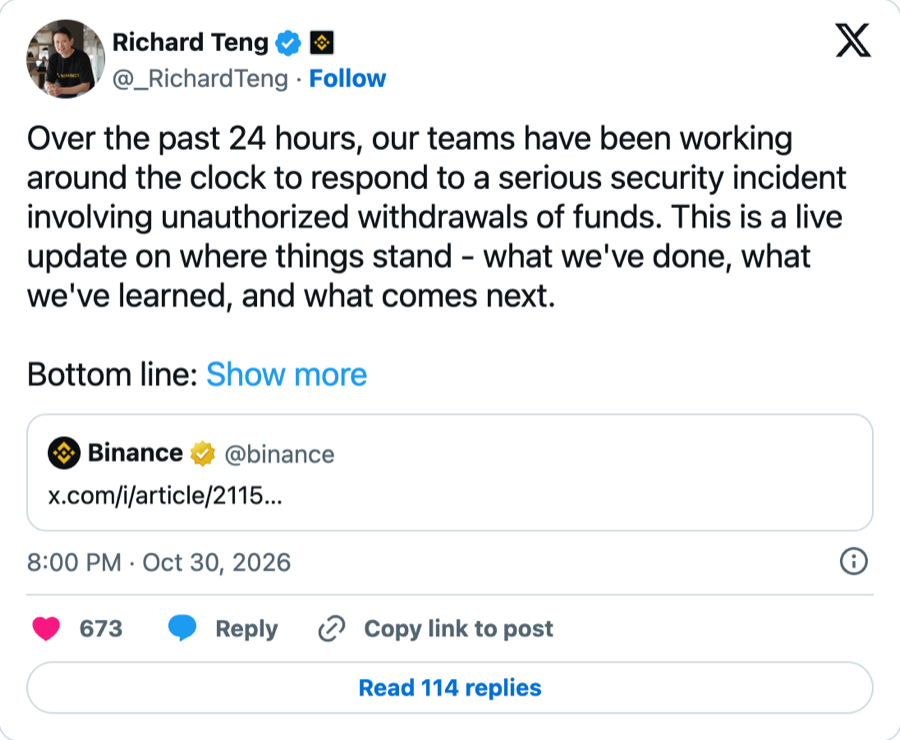
Binance published Security Incident Update #2, signed by co-CEOs Yi He and Richard Teng. The same text appears as an X Article (opens in a new tab) posted at 19:58 UTC on 30 October and on Binance’s support site (opens in a new tab), where the page is labelled “Published on 2026-10-30 19:33”. Richard Teng summarised it (opens in a new tab) at 20:00 UTC. Binance’s support site returns an anti-bot challenge to automated requests, so its text was read from the Internet Archive’s capture at 22:01 UTC (opens in a new tab); it matches the X Article. [vendor]
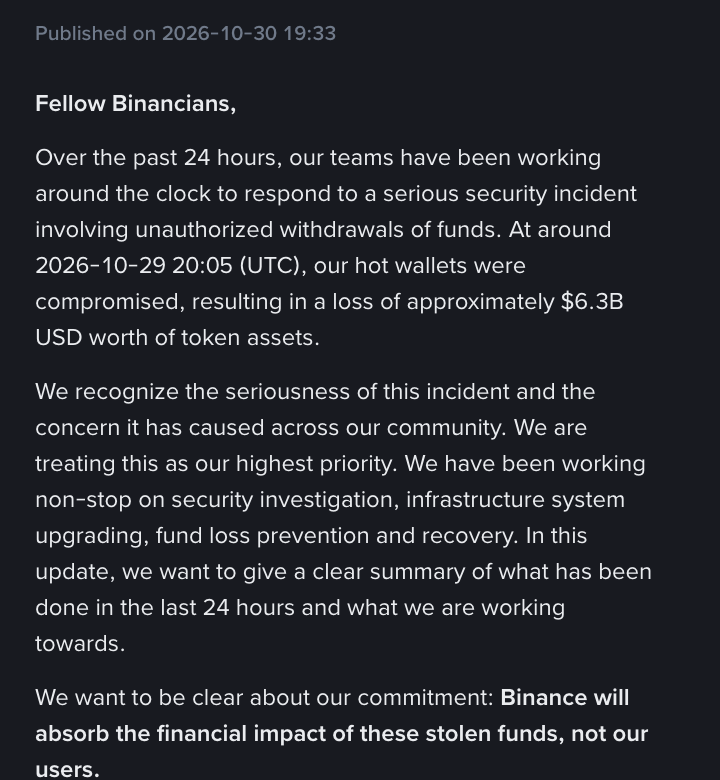
No new technical finding. On the root cause, Update #2 repeats what was already known: the incident “may involve a compromised laptop”, the investigation “has uncovered additional points of breach”, and “we have found no evidence that wallet private keys were leaked.” It says the team is working “to establish the full attack sequence” and expects “to share further technical findings within about 48 hours”, followed by “a detailed technical report”. [vendor]
One line touches the chain record: Binance says it “revoked affected authorizations”. The only revocation reproduced here is the hot wallet’s own zero-address authorization at 00:10:35 UTC on 30 October, described below; Update #2 does not say whether it means that transaction or others. [inferred]
Funds, withdrawals and reserves. [vendor]
| Item | Update #2 |
|---|---|
| Impact | “approximately $6.3B USD worth of token assets”, from “around 2026-10-29 20:05 (UTC)” |
| Company cover | “more than $6.34B in company funds”, with “$5B held in the exact impacted token assets”, “approximately 80% of the impacted amount”; the rest being bought “through market and OTC channels” |
| Who pays | Binance will cover losses through SAFU “and our corporate treasury” |
| Frozen | “Approximately $3 billion has been frozen on-chain to date”, unchanged from 10:55 UTC |
| Withdrawals | Still paused; target to “start resuming the withdrawal service within approximately 34 hours”, in phases, “subject to the completion of security checks” |
| Deposits | “Deposits and other unaffected platform services remain operational” |
| Proof of Reserves | “an initial Proof Of Reserves snapshot in 12 hours”, results “by Monday 2026-11-02” |
| Investigation | “Further technical findings within about 48 hours”, then “a detailed technical report” |
Counted from the 19:58 UTC post, those deadlines fall at about 07:58 UTC on 31 October for the reserves snapshot, about 05:58 UTC on 1 November for the first withdrawals and about 19:58 UTC on 1 November for the technical findings. The earlier 04:36 UTC post had said withdrawals would resume “within 48 hours”, which also points to early 1 November. These are our arithmetic on Binance’s own wording, not commitments to a clock time. [inferred]
At 02:12 UTC on 31 October, Binance’s X timeline (opens in a new tab) showed Update #2 pinned and nothing newer. No statement of resumed withdrawals, a Proof of Reserves result or new recovery figures had been published. Update #2 attributes the attack to no one; the North Korea attribution remains TRM’s (opens in a new tab), made “with high confidence”. The gaps this article lists, how the signatures were obtained and which approval control was bypassed, remain open. [vendor]
Update, 30 October 2026, 17:36 UTC
The operator account’s history before the theft is now reproduced. It shows the funding, test runs and rehearsal that TRM (opens in a new tab) describes. Method: historical balance and nonce queries on 0x7c8601…5ca0, then blocks, receipts and traces, all through dRPC alone.
| UTC | Operator activity | Evidence |
|---|---|---|
| 28 Oct, 07:39:47 | First funding: 0.0983 ETH from the Tornado Cash 0.1 ETH pool, via relayer | 0xd9e590…9008 (opens in a new tab) |
| 28 Oct, 08:53:59 | Second Tornado Cash withdrawal, 0.0979 ETH | 0xa79503…221a (opens in a new tab) |
| 29 Oct, 02:28:59 | First transaction: creates contract 0x19bee2…f2bf |
0x6b76e8…06d8 (opens in a new tab) |
| 29 Oct, 08:23:11 | Third Tornado Cash withdrawal, 0.0979 ETH | 0x18ae9a…1cae (opens in a new tab) |
| 29 Oct, 13:51:35–14:24:11 | Delegates two test wallets to that contract, with 2 and 3 consecutive-nonce authorizations, then calls each | 0x16b5ac…9dca (opens in a new tab), 0xec5af2…21d9 (opens in a new tab) |
| 29 Oct, 15:59:11 | Creates the final delegate 0x63e842…6fae |
0x97408e…329c (opens in a new tab) |
| 29 Oct, 16:20:47–16:47:23 | Rehearsal: delegates a third wallet to the final delegate, then calls it twice | 0xb2148e…5782 (opens in a new tab), 0x2b8eb6…f58f (opens in a new tab) |
| 29 Oct, 18:20:47 | Receives 1.0822 ETH from unidentified account 0xe4f907…74cd |
0x96cae1…ebe5 (opens in a new tab) |
| 29 Oct, 20:20:59 | Installs the delegation on the Binance hot wallet with 50 authorizations | Reproduced above |
[reproduced] The pool 0x12D66f…B8Fc and the router 0xd90e2f…F31b used by all three withdrawals are on Treasury’s 8 August 2022 Tornado Cash designation (opens in a new tab). The first funding came 36h25m before the first XRP outflows. The rehearsal delegation came 4h00m12s before the Binance installation, which matches TRM’s “four hours after that rehearsal.” The test wallets used the same consecutive-nonce batching later used against Binance. All three still carry their delegation code. The test wallets’ owners are not identified.
These transactions establish that the attack code was deployed, tested and rehearsed on-chain during the 18 hours before the theft. They do not date the Binance signatures or show how they were obtained. TRM notes that “early indicators” suggested phished authorizations, but says that explanation “leaves the other chains unexplained.” [inferred]
TRM also reports a later wave around 23:05 UTC reaching Binance wallets on Avalanche and Polygon; this was not reproduced here. On attribution, TRM states “high confidence” in North Korea’s TraderTraitor. Investigator ZachXBT (opens in a new tab) reported at 04:51 UTC on 30 October that Binance funds arriving via THORChain were commingled at 0x15104a…feb7 with proceeds of the $388M Bitget exploit, which he says “indicates the same actor is likely behind both incidents.” Neither attribution was reproduced here.
Update, 30 October 2026, 16:09 UTC
Two further read-only chain checks extend the reproduced path. Both follow leads first published by Blockaid (opens in a new tab). They used dRPC only (eth_getTransactionByHash, eth_getTransactionReceipt, eth_getTransactionCount, eth_getCode, trace_transaction and debug_traceTransaction), without a second provider. The two trace methods agree. The original article below is unchanged.
Preparation started hours earlier. The account that later submitted the 50 authorizations created the delegate contract 0x63e842…6fae in 0x97408e…329c (opens in a new tab), block 26,299,449, at 15:59:11 UTC on 29 October. That is 4h21m48s before the delegation and about four hours before the first XRP outflows TRM reports. The account’s nonce was already 5, so it had sent five earlier transactions. [reproduced] This dates the attacker’s on-chain preparation, not the signatures: a contract address created this way can be computed in advance from the sender and its nonce, so the authorizations could have named the delegate before it existed. [inferred]
The delegation reached a contract that trusted the wallet. In 0xdc102d…7481 (opens in a new tab), block 26,300,855 at 20:41:23 UTC, the same outer sender called the delegated hot wallet. The call trace shows the hot wallet calling smart account 0xee7ae85f2fe2239e27d9c1e23fffe168d63b4055 with selector 0xb61d27f6, commonly execute(address,uint256,bytes). The smart account accepted the call and transferred 780,000,000 USDC to the sweep destination. [reproduced] The smart account authorized its caller by address. Once that address ran attacker-chosen code, a contract that trusted it was exposed as well. Blockaid labels the smart account as Binance’s and reports a further 43m USDC. The account’s authorization rules were not decompiled. [inferred]
Sweeps continued after the first burst. A later call through the delegated wallet, 0x55ba4d…0556 (opens in a new tab) at 21:44:11 UTC, moved 200,397,771.82 USDT and other tokens to the same destination. [reproduced]
These findings do not change the open question: how the attacker obtained the hot wallet’s authorization signatures.
What the evidence shows
The timeline from chain data and company statements
| UTC | Event | Evidence |
|---|---|---|
| 29 Oct, 20:05 | TRM reports XRP Ledger outflows beginning, before any Ethereum delegation | TRM report |
| 29 Oct, 20:20:59 | Type-4 transaction installs delegation on the hot wallet, block 26,300,753 | [reproduced] |
| 29 Oct, 20:24:23 | Same outer sender calls the delegated wallet; 167,464.2479 ETH moves out | [reproduced] |
| 30 Oct, 00:10:35 | Zero-address authorization; wallet code is empty at block 26,301,896 | [reproduced] |
| 30 Oct, 02:25 | Initial statement, visible “last edited” time: possible laptop, container, withdrawals | [vendor] |
| 30 Oct, 04:36 | “Multiple factors”; the computer “may be the entry point” | [vendor] |
| 30 Oct, 07:37 | Teng: not one engineer’s permissions, not a single “one-click” action | [vendor] |
| 30 Oct, 08:47 | “Additional points of breach”, not named | [vendor] |
| 30 Oct, 14:33:37 | Teng’s written transcript names EIP-7702 delegation outside normal approvals | [vendor] |
(TRM (opens in a new tab), initial (opens in a new tab), 04:36 (opens in a new tab), 07:37 (opens in a new tab), 08:47 (opens in a new tab), 14:33:37 (opens in a new tab))
The initial post’s 02:25 timestamp is an edit label, so it does not show what the first version said. The 14:33:37 transcript accompanies a video posted at 14:32:09, and Binance’s account shared it at 14:34:37. The written transcript was checked; the audio was not transcribed independently.
What Binance has said about access and approvals
The initial statement says the investigation “suggests that the security incident may involve a compromised DevOps engineer’s laptop, which allowed an attacker to gain access to a service container and submit unauthorized withdrawal transactions.” It adds: “We have found no evidence of any wallet private key leak.” [vendor] (initial (opens in a new tab))
Teng’s 14:33 transcript says: “Our initial investigation suggested that the security incident may have involved a compromised laptop, however our subsequent investigation has uncovered additional points of breach.” On the mechanism, it says exactly: “The attacker used a known multi-signature protocol EIP-7702, to obtain on-chain execution approval over a hot wallet. That delegation did not pass through our normal approval controls.” [vendor] (transcript (opens in a new tab))
The description of EIP-7702 in that quote is inaccurate. The specification (opens in a new tab), titled “Set Code for EOAs”, lets an account’s key sign an authorization that points the account at contract code. It is code delegation, not a multisignature scheme, and the quote says nothing about Binance’s internal signing topology. What the statement does add is a company finding that the delegation bypassed normal approval controls. It does not say which control was skipped, who or what requested the signature, or why the request was not stopped.
The transcript also says: “The attacker also used a self-destruct mechanism that destroyed tooling and traces as they went, making it more difficult for us to trace and investigate.” No host, artifact or timestamp accompanies it. This is a company statement that was not reproduced here, and it does not refer to the EVM SELFDESTRUCT opcode. [vendor] (transcript (opens in a new tab))
The reproduced Ethereum path
The reproduction used read-only JSON-RPC methods (eth_getTransactionByHash, eth_getBlockByNumber, eth_getTransactionReceipt, eth_getCode, eth_getTransactionCount, trace_transaction) against dRPC (opens in a new tab) and PublicNode (opens in a new tab). Both returned the same signed transactions and block headers. Historical code, nonces and the sweep trace come from dRPC alone: PublicNode answered all six historical code requests with HTTP 403. Transaction hashes and signatures were then recomputed offline. No local node, state proofs or full block replay were used, so the results reflect provider-returned data checked for internal consistency.
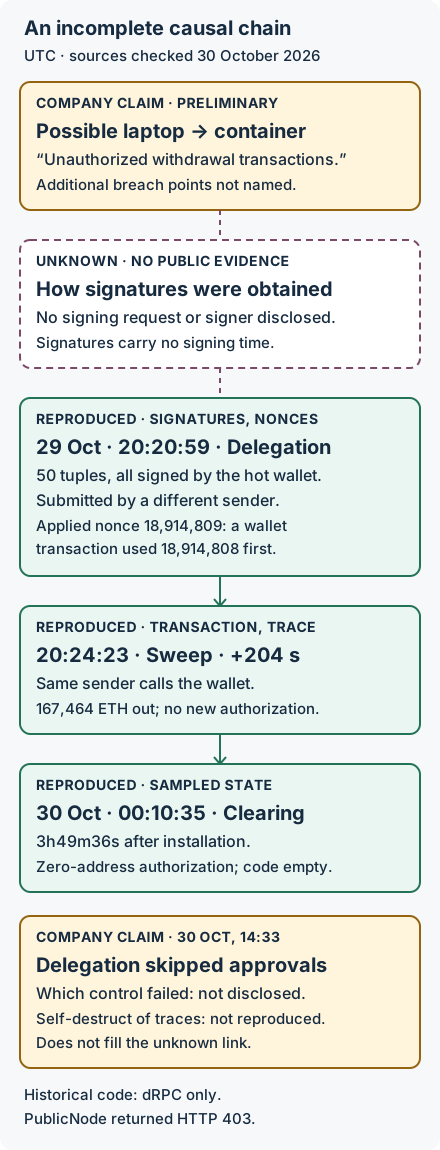
The installation transaction, 0xad9926…1298b (opens in a new tab), is type 4, in block 26,300,753 at 20:20:59 UTC. Its outer signature recovers 0x7c8601d4645b93cea45f71e118a729332e6b5ca0. It targets 0x28c6c06298d514db089934071355e5743bf21d60, which Blockaid (opens in a new tab) labels “Binance 14”; that ownership label is researcher attribution, not chain data. The transaction carries 50 authorization tuples, and the signature in every one of them recovers the hot-wallet address, not the outer sender. All 50 point at delegate 0x63e842b054bd624a465454d533c33f573e9c6fae. The wallet’s code is empty at block 26,300,752 and 0xef0100 plus the delegate address at 26,300,753. [reproduced]
The signatures are valid under the protocol’s recovery rules. The chain did not accept a forged signature; the wallet’s own authority signed these delegations. Someone else submitted them.
The tuples carry nonces 18,914,824 down to 18,914,775. EIP-7702 applies a tuple only when its nonce equals the authority’s current nonce, then increments it, so the 49 others fail even though their signatures are authentic. The wallet’s nonce was 18,914,808 at the end of the previous block. In the same block, an ordinary wallet-originated transaction (opens in a new tab) at position 133 used nonce 18,914,808, before the installation at position 138. That left 18,914,809 current, which is the tuple Etherscan’s authorization table (opens in a new tab) marks valid. The end-of-block nonce, 18,914,810, agrees. [reproduced], with the valid-tuple flag taken from the explorer.
At 20:24:23 UTC, 204 seconds after installation, the same outer sender called the wallet in 0x53bd38…e2f3 (opens in a new tab). The outer transaction has zero value and no authorization list; the trace shows the wallet sending 167,464.2479 ETH to 0x5227f603c1ee34ce3c06efe6477003bdfccb2f8c. Once installed, the delegation needed no further wallet signature. [reproduced]
The clearing transaction (opens in a new tab) is signed by the hot wallet itself, with outer nonce 18,914,903 and a zero-address authorization at 18,914,904; the sender nonce increments before authorizations are processed. Code is still delegated at block 26,301,895 and empty at 26,301,896, 00:10:35 UTC on 30 October, 3h49m36s after installation. These are sampled block states, not continuous observation, and clearing a delegation is not evidence about key rotation or remediation. [reproduced]
What each type of evidence can and cannot prove
| Evidence | Establishes | Does not establish |
|---|---|---|
| Company statements | Binance’s current findings: possible laptop entry, container access, extra breach points, approval bypass, self-destruct claim | Infection route, container identity, the breach points, the control that failed |
| Recovered signatures | The hot-wallet authority signed 50 delegations; another account submitted them | When, where or through which interface they were signed; whether a key was extracted |
| Nonces and block order | Which tuple applied and why | That the attacker lacked the live nonce, or how long access lasted |
| Code and trace (dRPC) | Delegation installed, used for the sweep, cleared later | Consensus-validated state; continuous state between samples |
| Researcher reports | Ordinary signed transfers from other wallets and chains | Internal forensics; key custody |
An EIP-7702 authorization signs only the chain ID, delegate address and nonce. It contains no signing time and nothing about the later sweep. The signatures existed by 20:20:59; they could have been produced long before. Neither the 50-nonce window nor the 204-second gap measures how long anyone had access to a signer. Valid signatures are also equally consistent with a misused signing service and with an extracted key, so Binance’s “no evidence” of a key leak is a statement of investigative status, not an exclusion. [inferred] (EIP-7702 behaviour (opens in a new tab))
What is still unproven
Signer-service compromise is an assessment
TRM writes that “the most likely explanation is that the attacker gained the ability to make Binance’s hot wallet signing system sign transactions of its choosing across chains,” and says the 50 authorizations suggest “the access may have been limited in time, or that signatures had to be requested through a system.” Elliptic says the attacker “appears to have been able to get Binance’s own systems to sign transactions on their behalf.” (TRM (opens in a new tab), Elliptic (opens in a new tab))
Their strongest supporting observation is that other wallets, including one on Ethereum and wallets on several other chains, sent funds through ordinary signed transfers with no delegation. One such Ethereum transfer, 0x51f263…d39f (opens in a new tab), was retrieved for this note: a direct value transfer with no authorization list, signed by the wallet Blockaid labels “Binance 16”. [reproduced] This rules out delegation as the explanation for the whole incident. It does not show whether the attacker drove one signing service or held several keys.
Blockaid’s current text calls it a “hijacked signing service”; a saved comparison with an earlier snapshot shows the wording became stronger without new signer logs. Chainalysis (opens in a new tab) describes “valid signed authorizations” and ordinary transfers without an internal path. The evidence these firms publish is chain data; none of it demonstrates access to Binance’s hosts or signer logs. (Blockaid (opens in a new tab))
The unestablished links
The laptop and container account and the reproduced path describe different layers. Binance says a container was used to “submit unauthorized withdrawal transactions”; on Ethereum, the delegation and sweep were submitted by an outside account carrying the wallet’s signatures. No public source says whether the container produced those signatures, requested them from a signer, or played no part in them. [inferred]
Still undisclosed in the sources checked: the laptop’s infection route; the container and the credential used; what the “additional points of breach” are and how they relate to the laptop; the signing request behind the 50 authorizations and the system that served it; the approval control the delegation avoided and why; and any key-export audit.
The Ethereum execution path is reproducible. The path from the laptop to the signatures is not established. Binance has said a technical post-mortem will follow; until then, the root cause remains a company account with a gap where the signature acquisition should be.
Sources
-
Binance, 3 November 2026: “29 October 2026 Binance Security Incident: Initial Findings and Response Update” on its blog (opens in a new tab), read from the Internet Archive’s capture at 16:05:59 UTC (opens in a new tab) and the capture at 13:35:03 UTC on 4 November (opens in a new tab), same text (signing service, attack chain, 50 signing transactions, MPC revocation, 23:56 and 00:10 UTC, $6.34 billion, $2.85 billion, 98%, remediation, FBI link); X Article (opens in a new tab), posted 14:33:06 UTC, same text. Read on 4 November 2026 at about 22:40 UTC.
-
Binance, 3 and 4 November 2026: Recovery Update #6 (opens in a new tab), published 02:40 UTC 3 November, read from the Internet Archive’s capture at 03:04:12 UTC (opens in a new tab); Recovery Update #7 (opens in a new tab), X Article posted 15:26:23 UTC 4 November (about 98% covered, 44-token Proof of Reserves snapshot, 50 to 60 hours for the proof); Yi He (opens in a new tab), 16:57:29 UTC 4 November, same snapshot.
-
Binance, 1 November 2026: Recovery Update #4, “Withdrawals Resume in Phases” (opens in a new tab), published 04:08 UTC, read from the Internet Archive’s capture at 09:15 UTC (phase-one networks and assets, 95% covered, new reserve addresses, post-incident report wording); X Article (opens in a new tab), same text; X posts Bitcoin first, 06:20:36 UTC (opens in a new tab), Ethereum and BSC restored, 07:49:25 UTC (opens in a new tab), Proof of Reserves addresses updated, 06:53:51 UTC (opens in a new tab); customer support, 08:13 UTC (opens in a new tab) (phase one covers 15 networks). The support site returns a bot challenge to automated requests.
-
FBI, 31 October 2026: North Korea Responsible for $6 Billion+ Binance Attack (opens in a new tab), a cyber alert, not a press release (DPRK attribution, TraderTraitor, ETH conversion, the lists of 608 Ethereum, 19 Bitcoin and 1 Solana addresses). Read as text on 1 November 2026 at 13:44 UTC; the site answered both
curland a headless browser with a Cloudflare challenge. The address count is a count of that text. -
Associated Press, 31 October 2026: FBI blames North Korea for stolen billions from Binance in biggest hack in history (opens in a new tab) (Trump’s remarks on the attribution).
[reported]; no transcript of the exchange with reporters was located. -
Binance and Richard Teng on X, 30 October 2026: initial statement, last edited 02:25 UTC (opens in a new tab) (impact estimate, laptop and container, key-leak wording); 04:36 (opens in a new tab); Teng, 07:37 (opens in a new tab); 08:47 (opens in a new tab); Teng video, 14:32:09 (opens in a new tab); Teng transcript, 14:33:37 (opens in a new tab); Binance share, 14:34:37 (opens in a new tab). Binance support and Square pages returned WAF challenges and were not read.
-
Researcher reports, current versions retrieved 30 October 2026, 14:50 UTC: TRM (opens in a new tab) (metadata: published 02:10, modified 02:38 UTC); Elliptic (opens in a new tab) (modified 13:16 UTC); Blockaid (opens in a new tab) (modified 14:27:54 UTC); Chainalysis (opens in a new tab) (modified 10:41 UTC).
-
EIP-7702: Set Code for EOAs (opens in a new tab), checked 30 October 2026: authorization digest, nonce rules, delegation and clearing.
-
Transactions: installation (opens in a new tab), same-block wallet transaction (opens in a new tab), sweep (opens in a new tab), clearing (opens in a new tab), Binance 16 transfer (opens in a new tab).
-
Read-only reproduction, 30 October 2026, 14:50 to 14:52 UTC: dRPC (opens in a new tab) and PublicNode (opens in a new tab) JSON-RPC, chain ID 1, head block 26,306,279. Offline reserialization reproduced the installation, sweep and clearing hashes and outer senders from both endpoints, and recovered the hot-wallet authority from all 50 installation authorizations. Historical code, nonce and trace results depend on dRPC; PublicNode returned HTTP 403 for historical code. No local node, state proofs, full block replay, delegate decompilation or non-Ethereum replay.


